

Customer interview evidence becomes useful when a reader can trace a claim back to a specific conversation, understand what supports or challenges it, and see what the team will learn next. Keep the source excerpt, your interpretation and the decision in separate fields. Count interviews separately from excerpts, and preserve contradictory observations instead of hiding them in a positive summary.
This guide uses a small, entirely fictional agency example. It demonstrates an analysis workflow, not a sample size recommendation or evidence that a particular product should be built. You can start with the free customer interview brief for Notion HTML import or use the fields below in your existing research system.
What counts as customer interview evidence?
For this workflow, evidence is a locatable excerpt, faithful paraphrase or recorded observation that is relevant to a defined learning question. A conclusion such as “agencies need automated reminders” is an interpretation. It needs a source and an explanation of how the source supports it.
Keep different kinds of material distinct. A participant reporting a recent event is different from the interviewer observing an action. A feature suggestion expresses an opinion. A contradiction challenges a proposed explanation. These categories are practical labels for this example; they are not a universal scoring scale.
Product Talk’s account of story-based interviews recommends grounding conversations in specific past experiences. You can apply that principle by asking about a recent event, then preserving its context when you summarize it. The worked case and file structure below are original TemplateBase teaching material.
Start with the decision you need to inform
Imagine a team exploring agency handoffs. Its learning question is: how does an approved scope reach the delivery owner, and where does that process break down? The immediate decision is whether to run a small manual handoff test. The team has not decided to build a reminder feature.
This framing keeps the interview focused on an existing workflow. It also makes a negative or contradictory observation useful. An agency that already handles the handoff well can reveal conditions the team would miss if it only collected complaints.
Capture enough context to revisit the claim
For every interview, keep a stable pseudonymous ID, date, segment, role, workflow context, source location and research owner. Record the status of your organization’s permission process. A spreadsheet permission label is a record of a decision; it cannot obtain consent or control access to a recording.
For every excerpt, keep its own ID, the interview ID, the opportunity it concerns, an evidence-kind label, a short source excerpt or faithful paraphrase, a precise locator and a reviewer. A timestamp or note paragraph is more useful than a link to a large folder with no indication of where the claim appears.
Store the original records in your own approved restricted system. Use only material you are permitted to use. The workflow should remain understandable without copying names, emails or whole transcripts into a shared product-planning file.
Worked example: four items from three interviews
All events and people in this table are fictional. The opportunity is OP-01: delivery starts without a clearly confirmed scope owner.
| Item / interview | Evidence | How it affects the explanation |
|---|---|---|
| EV-001 / INT-001 | A team began a job using an outdated scope link. | Reported event supporting a handoff problem. |
| EV-002 / INT-001 | The same participant later asked which version was approved. | A second excerpt from the same interview, not a second customer. |
| EV-003 / INT-002 | A project manager searched three folders for the approved scope during a fictional demonstration. | An observed action relevant to finding the approved version. |
| EV-004 / INT-003 | A single owner and versioned link already work for this agency. | A contradiction to the claim that the process fails in the same way everywhere. |
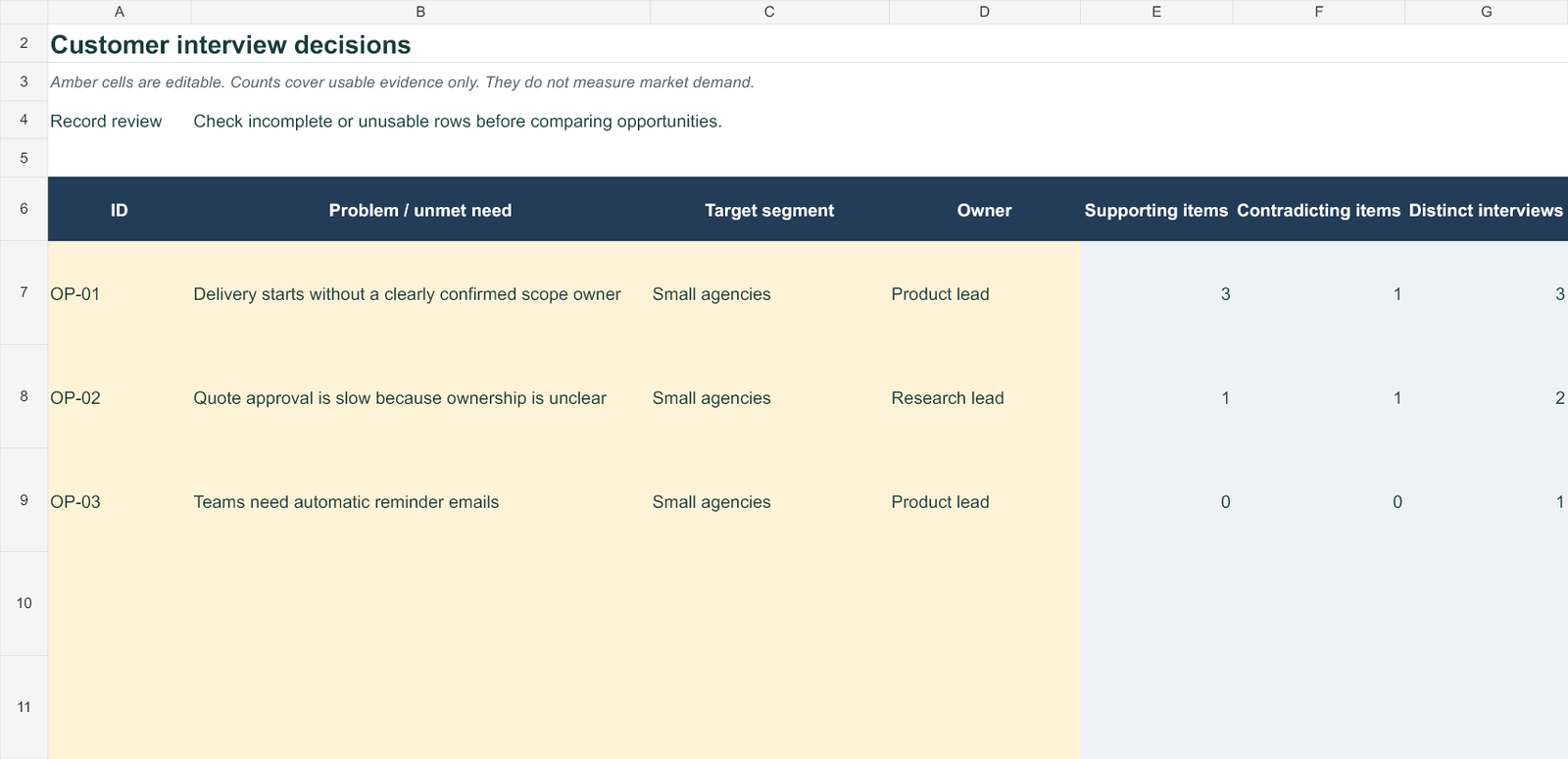
The record contains three supporting items, one contradicting item and three distinct interview IDs. It does not contain four independent customer endorsements. The two INT-001 excerpts help explain one account in more detail; they do not increase interview coverage.
Distinct interviews also does not automatically mean distinct people or companies. Two sessions with one participant may have different interview IDs. Before comparing coverage, check the underlying participant and company population.
Preserve the contradiction and change the next question
It would be easy to summarize the first three items as “handoffs are broken.” INT-003 makes that claim too broad. A more careful interpretation is that approved-scope information may not reach the delivery owner reliably under some handoff conditions.
The team can now investigate those conditions: who owns the handoff, how versions are identified, where approval is recorded, and what happens when a person is away. This leads to a more useful test than asking everyone whether they would like automatic reminders.
In the fictional next step, a product lead observes a manual handoff with three consenting teams and records whether a delivery owner and approved scope can be located without prompting. Three is a planning choice in this example, not a recommended statistical threshold. The team also records disconfirming observations and reviews the result on an agreed date.
Keep a feature suggestion separate from behavioral support
A fourth fictional interview supplies one suggestion: automatic reminder emails. It does not describe a recent missed follow-up. Record it as an opinion and a question to investigate. Do not translate it into a confirmed purchase commitment or a quantified revenue opportunity.
The example workbook therefore shows zero supporting behavioral items for OP-03 and one distinct interview. That is not a claim that reminders have no value. It shows the type of evidence currently recorded. A team might park the feature while it observes how follow-up works today.
Use entry checks before trusting the summary
Simple data problems can create a persuasive but misleading summary. A duplicated evidence ID can inflate a count. A missing interview key breaks provenance. An excerpt without a locator is hard to review. A permission record still marked Pending should not quietly become usable evidence in a shared output.
The Customer Interview Evidence Workbook exposes these cases in its input states. It counts only usable entries, keeps contradictions separate and deduplicates usable interview-opportunity pairs. It does not verify transcripts, classify statements for you, measure prevalence or rank the roadmap automatically. A status of Ready for review means the required fields are present, not that research or demand has been validated.
Connect research to the relevant operating decision
The next document should match the question. If evidence points to scope and delivery pressure, examine your actual client-month costs and scope data before changing pricing or staffing. If you need to explain what was learned in a customer meeting, separate the learning from the customer’s measured adoption and agreed follow-up.
For fundraising, describe research honestly: who was interviewed, how they were selected, what they reported, what contradicted the story and what remains uncertain. The pitch deck guide helps place evidence in the wider presentation. An interview log cannot substitute for signed contracts, actual usage, retention or revenue records.
A reusable decision record
- Question: which workflow or assumption are we investigating, for which segment?
- Evidence: which interview IDs and source locators support the interpretation?
- Contradictions: what does not fit, and which alternative explanations remain?
- Coverage: how many distinct interviews, people and companies are represented, and how were they selected?
- Next learning step: what will we observe, who owns it and when will we review it?
Use the free interview brief for one conversation. Use a linked register when you need to compare several conversations without losing their sources. Keep the limits of the evidence beside the decision it informs.
Common questions
How many customer interviews validate an idea?
No fixed count in this workflow validates an idea. The relevance of participants, the nature of the evidence, contradictions and the decision’s uncertainty matter. This example demonstrates record handling; it does not estimate a market conversion rate.
Should repeated quotes count as separate evidence?
They may be separate excerpts when they add context, with separate source locators. They still belong to one interview. Do not treat their repetition as additional independent customers.
Can AI summarize the interviews?
If your approved process permits it, a tool can assist with organization. Check each resulting claim against the original source, retain locators, label interpretations and preserve contradictions. This workbook does not contain AI integration or transmit your records.