

Customer renewal rate counts renewing customers from an eligible customer population; revenue retention weighs retained recurring value. A contract register needs an extra distinction: when one account has several contracts, a count of renewed contracts is a contract-event rate. It is not automatically a customer or logo-renewal rate.
This guide uses an entirely fictional contract-renewal cohort to explain the denominators, expansion and pending outcomes. It is a calculation method, not a benchmark or evidence that a template improves retention.
Define the population before calculating a rate
Start with a statement someone else can reproduce: all contract-renewal events due from October 1 through October 31, including both endpoints, in this register. Record the event ID, account ID, contract ID and due date. Check that the register contains the complete eligible set. A formula cannot identify a contract you omitted.
ClientSuccess’s renewal-process training distinguishes the count of renewing customers from recurring value renewed and explains that a maintained spreadsheet can support the workflow. Our example uses contract-renewal events as its counting unit. That label matters when an account appears more than once.
Use one currency and a consistent annualized recurring basis before and after renewal. Exclude one-off implementation fees, tax, cash collections and unrelated new-customer sales. A two-year total contract value cannot be compared directly with a one-year recurring amount.
Worked example: five renewal events
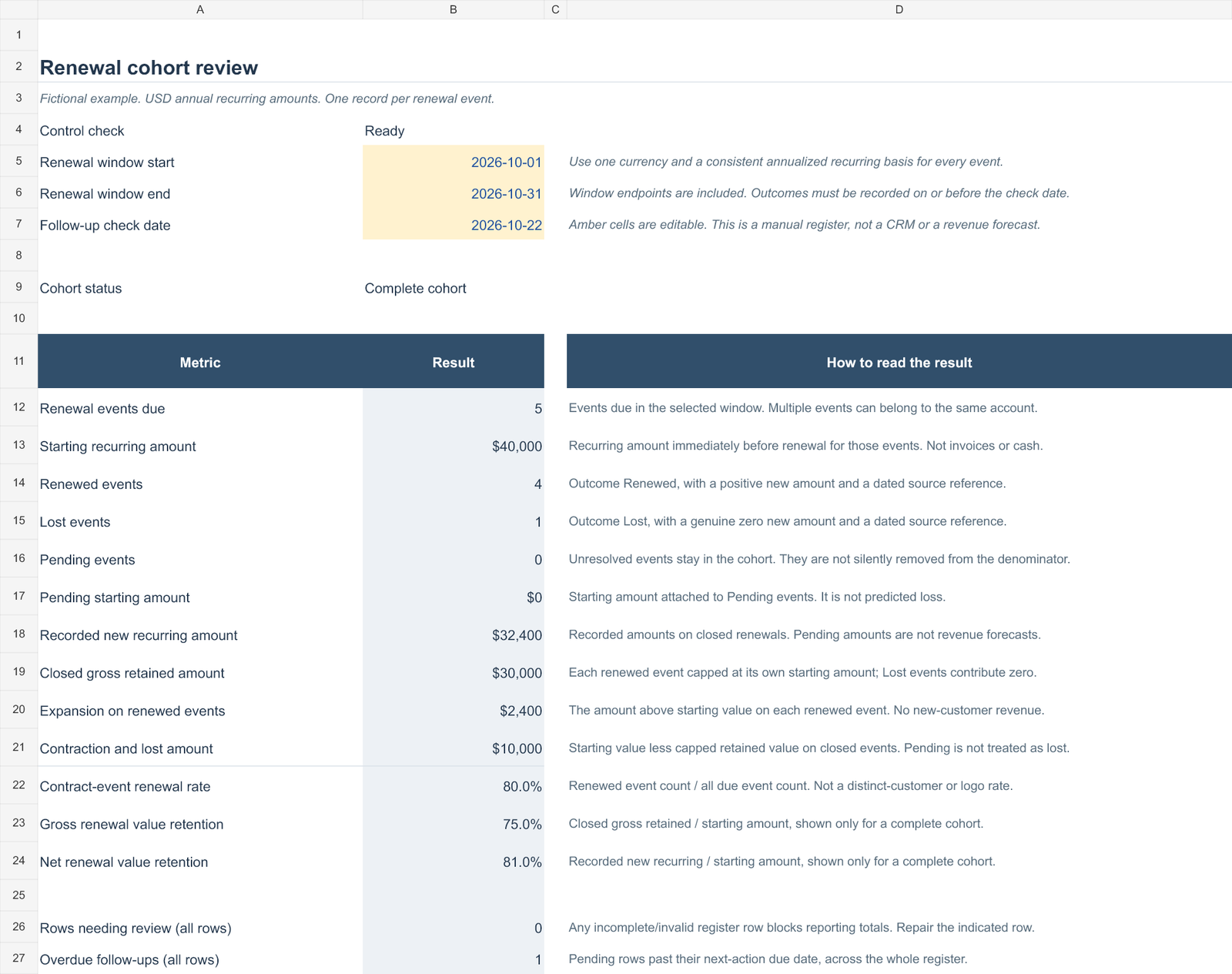
All accounts, contracts, dates and amounts below are invented. Account A has two different contracts. The five events belong to four accounts, and all five outcomes have been recorded by the October 22 check date. A contract due October 31 was renewed early.
| Event / account | Starting annual amount | Outcome | New annual amount | Gross retained amount |
|---|---|---|---|---|
| EV-001 / A, contract 1 | $12,000 | Renewed | $14,400 | $12,000 |
| EV-002 / B | $10,000 | Renewed | $8,000 | $8,000 |
| EV-003 / C | $8,000 | Lost | $0 | $0 |
| EV-004 / D | $6,000 | Renewed | $6,000 | $6,000 |
| EV-005 / A, contract 2 | $4,000 | Renewed | $4,000 | $4,000 |
| Total | $40,000 | 4 renewed, 1 lost | $32,400 | $30,000 |
The three useful results are:
- Contract-event renewal rate: 4 renewed events / 5 due events = 80%.
- Gross renewal value retention: $30,000 capped retained / $40,000 starting amount = 75%.
- Net renewal value retention: $32,400 new recurring / $40,000 starting amount = 81%.
The rates answer different questions. The count-based result gives equal weight to every renewal event. Value measures give more weight to larger starting amounts. Do not average individual event percentages to produce aggregate value retention: the unweighted net average here is 80%, while the correctly weighted total is 81%.
Separate expansion from retained starting value
EV-001 rises from $12,000 to $14,400. For the gross value measure, cap it at its own $12,000 starting amount. The additional $2,400 is expansion. EV-002 contracts by $2,000 and EV-003 loses $8,000, producing $10,000 of contraction and lost value. Expansion partly offsets that loss in the net measure.
The six-percentage-point difference between 81% net and 75% gross value retention is $2,400 / $40,000. It does not mean six more customers renewed. A higher net value result can coexist with a lost contract.
ChartMogul’s explanation of company retention metrics excludes expansion from gross retention and includes it in net retention, while keeping the original customer base as the population. Our example uses a selected due-date cohort and caps value per renewal event. Call these renewal-cohort value measures; they are not automatically the company’s whole-base GRR or NRR.
Keep pending outcomes in view
Now imagine EV-004 has not reached a decision. Its starting value is still $6,000. Leave its new amount and outcome date blank rather than entering zero. The cohort still contains five events and $40,000 of starting value, with $6,000 unresolved.
The known closed new amount is $26,400 and the known capped retained amount is $24,000. Those are closed-to-date dollar amounts, not final cohort rates. Dropping the pending event from the denominator quietly changes the population. Treating its blank new amount as a known zero turns uncertainty into a loss.
One defensible reporting policy is to show the unresolved count and value, then withhold final rates until all selected outcomes are known. That is this example workbook’s policy. If your organization reports provisional rates or forecasts instead, label the population, assumptions and unresolved amount explicitly; an uncalibrated probability is not an observed renewal.
Separate the cohort from the follow-up queue
The fictional register also contains an event due November 15 with a $5,000 starting amount. It is outside the October cohort, so it contributes nothing to that denominator or retained value. Its next action was due October 20. At the October 22 check it belongs in the overdue follow-up queue.
A date-based follow-up can be urgent even when the renewal is outside the reporting window. Give each pending event an owner, a concrete next action and a due date. A colored cell cannot perform that action or prove it was completed.
For this small task, the free Excel renewal follow-up calendar calculates a date from your chosen lead calendar days. November 10 minus 30 calendar days is October 11. Lead days are a planning choice, not an interpretation of a contract’s legal notice requirements.
Check the register before discussing the result
Check event IDs and the account/contract/due-date combination. Two different event IDs should not make the same contract renewal count twice. A repeated account ID can be legitimate when it has different contracts, which is another reason to avoid labeling the event count as customer retention.
Check actual dates rather than text, positive starting recurring amounts on the same basis, and genuine numeric zero for a Lost outcome. Require a source reference and date for a closed outcome. A nonempty reference makes a record locatable; it does not authenticate the document or prove commercial approval.
The Customer Renewal Cohort Workbook packages the register and selected-window review into editable Excel files. It flags these preparation issues and suppresses final rates while selected outcomes are pending. You remain responsible for the complete population and accurate records. The files do not connect to a CRM, send reminders or predict decisions.
Use the result in the right conversation
In a customer review, pair the renewal record with measured adoption, agreed outcomes and next actions. The QBR worked example explains an adoption denominator and action owner. The board update guide helps separate reported metrics from decisions needed.
For operating forecasts, distinguish recorded renewal outcomes from assumptions about future MRR and cash timing. The SaaS financial model guide explains that broader task. A renewal event register is useful planning evidence; it does not replace a complete company revenue movement report.