

Workshop break-even is the number of paid seats whose contribution covers the event’s fixed costs, complimentary guests and your chosen host-pay allowance. Calculate that threshold before committing to the format. After the event, replace the estimate with actual ticket money, refunds, retained fees and incurred supplier costs. A refund can change cash and seats differently.
This guide follows one fictional illustration workshop. Every amount, fee, order and date is invented teaching data in USD. The method covers one event, one currency and a single planned ticket price. It excludes tax, chargebacks, unpaid reservations and statutory accounting.
Define the cost of one more paid seat
The U.S. Small Business Administration’s break-even guidance explains the relationship between fixed costs and unit contribution. For a workshop, separate costs that stay constant for the edition from costs that increase with each guest. Include preparation and delivery work in a visible host allowance if the event must cover that work.
Complimentary guests consume capacity and may use materials without buying a ticket. Put their planned cost beside the fixed cost to avoid spreading it across an assumed full room. Treat the fee convention explicitly: the following case assumes a percentage of ticket money plus a flat fee per paid seat. A provider that charges per order needs a different fee estimate for multi-seat orders.
| Input | Amount |
|---|---|
| Ticket price | 85.00 |
| Expected paid guests | 12 |
| Complimentary guests / total guest capacity | 1 / 16 |
| Fixed supplier costs | 320.00 |
| Cost per guest | 15.00 |
| Host allowance | 180.00 |
| Assumed fee | 3.2% plus 0.40 per paid seat |
| Desired surplus after host allowance | 150.00 |
Contribution per paid seat is 85 × (1 − 0.032) − 0.40 − 15 = 66.88. The amount those seats must cover is 320 + (1 × 15) + 180 = 515.00.
Break-even paid seats = ROUNDUP(515 / 66.88, 0) = 8
Paid seats for the 150 target = ROUNDUP((515 + 150) / 66.88, 0) = 10
Planned surplus at 12 paid seats = 12 × 66.88 − 515 = 287.56
At eight paid seats, the model leaves 20.04 after the host allowance. At seven, it shows a 46.84 shortfall. The threshold rounds upward because a fraction of a sold ticket cannot fill the gap. If contribution is zero or negative while there is a positive amount to cover, more seats at that price do not produce a finite break-even result.
Compare the threshold with capacity and booking evidence
One complimentary guest leaves 15 places for paid guests within the 16-person capacity. Both the eight-seat break-even point and ten-seat target fit. A target that requires more sellable places than the format supports needs a change in price, costs or scope.
Capacity does not establish demand. In a fictional review on 1 November, seven seats are confirmed while the budget still expects twelve. The host records a checkpoint on 7 November and the three additional bookings needed to reach the target. That date is an illustrative choice, not a cancellation policy or a recommendation for your venue contract. A record should name the owner, booking source and commitment deadline.
For a quick independent planning estimate, the free HereNow workshop pricing calculator is an alternative. Its page identifies exclusions including refunds and discounts. Keep those outside a simple planning estimate and reconcile them from actual records later.
Record refunded money and released seats separately
Use an order reference rather than a guest’s name. Record cumulative gross money after discounts, cumulative refunded money, net provider fees retained and the number of seats released. Updating one order record avoids counting a second refund as a second sale. The sample below uses positive refund and fee inputs, which the calculation deducts.
| Order | Seats sold | Released | Gross | Refund | Net retained fee | Net funds |
|---|---|---|---|---|---|---|
| W004 | 1 | 1 | 85.00 | 85.00 | 3.12 | −3.12 |
| W005 | 3 | 1 | 255.00 | 85.00 | 9.36 | 160.64 |
| W006 | 2 | 0 | 170.00 | 20.00 | 6.24 | 143.76 |
W004 returns all ticket money and releases its seat, while a retained fee leaves a negative 3.12. W005 releases one of three seats. W006 gives a partial money refund and retains both seats. A money refund alone therefore cannot tell you how many places remain active.
Stripe’s refund documentation describes partial refunds and states that original processing fees are not returned. The fee amounts in this case are fictional assumptions, not Stripe prices. Use your actual provider statement and agreement. If it returns a fee, record the net retained fee after that credit. Check refund status before treating a requested or failed refund as completed.
Use incurred costs for the completed edition
Do not recalculate every purchase as final attendance times the original guest allowance. This host bought 14 material kits for 168.00 and 15 refreshment portions for 45.00. With venue 180.00, assistance 90.00 and promotion 60.00, incurred supplier costs total 543.00. Those purchases stay in this simplified event review even when a guest receives a refund or does not attend. Reusable inventory or stock accounting needs separate treatment.
Across all eight fictional orders, gross ticket money is 1,095.00, refunds are 190.00 and net retained fees are 40.24. Thirteen seats were sold and two released, leaving eleven active paid seats. One comp makes twelve booked guests. Eleven people attended. Attendance and remaining bookings answer different questions.
| Measure | Amount |
|---|---|
| Gross ticket money | 1,095.00 |
| Less ticket refunds | 190.00 |
| Less net retained fees | 40.24 |
| Net ticket funds | 864.76 |
| Less incurred supplier costs | 543.00 |
| Less host allowance | 200.00 |
| Surplus after host allowance | 121.76 |
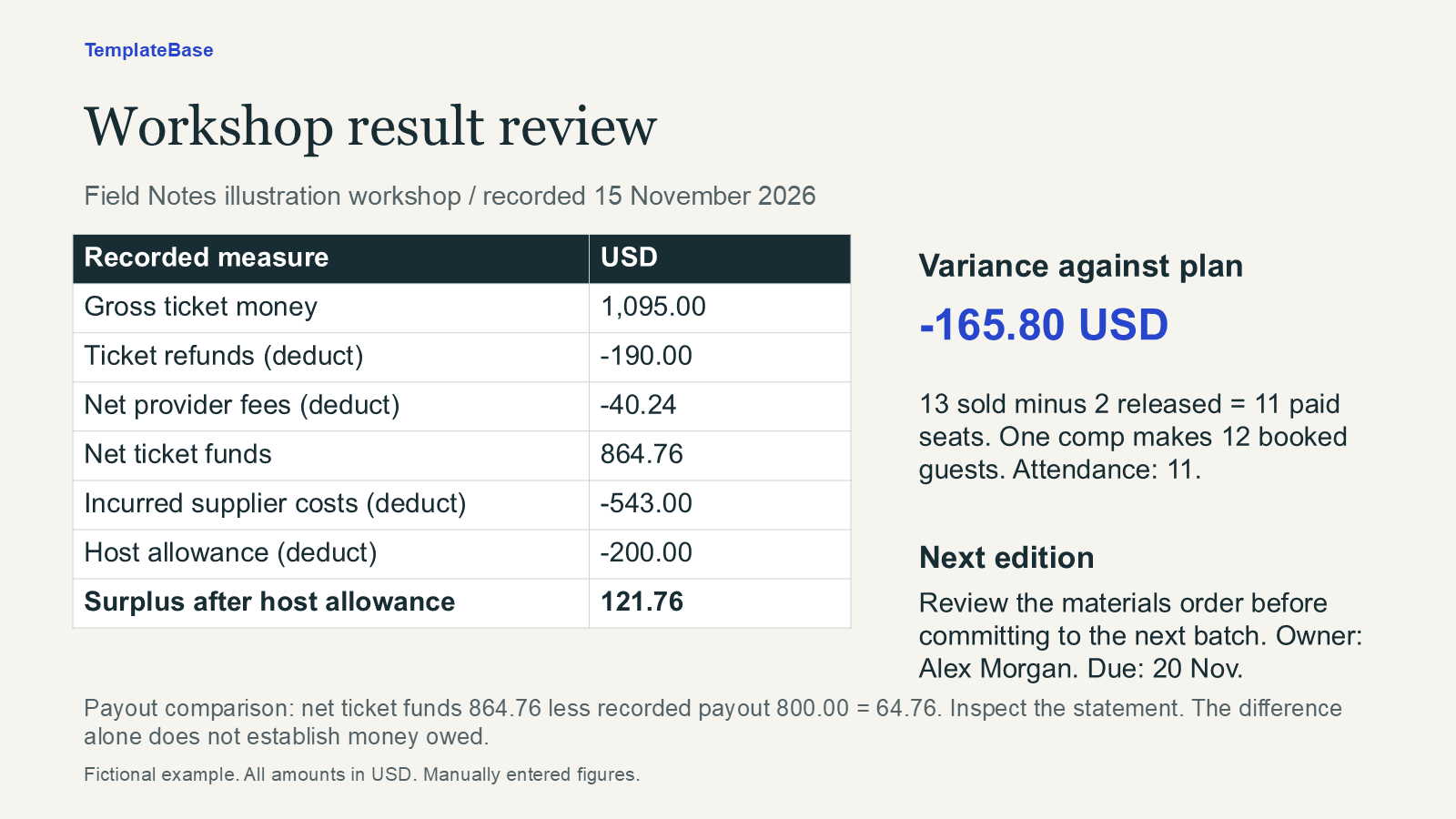
The recorded host allowance is 200.00, compared with the planned 180.00. The actual surplus is 121.76 − 287.56 = −165.80 below the plan. The measure helps review one event under the stated scope; it is not company-wide accounting profit.
Reconcile the payout before assigning a cause
If the entered net payout is 800.00, net ticket funds less that payout leave a comparison difference of 864.76 − 800.00 = 64.76. The difference does not by itself prove the provider owes 64.76. Align the reporting cutoff, event scope and treatment of fees, then inspect reserves, adjustments or missing records in the actual statement. Keep an unresolved item visible until its source explains it.
A surplus also does not identify the lowest bank balance before the event. Deposits, supplier dates and payout timing need a dated forecast. The separate weekly cash-flow guide demonstrates that timing question.
Finish with a record someone else can review
- Save the dated ticket plan and name the assumptions behind expected attendance.
- Check the threshold against sellable capacity and confirmed bookings before the next commitment.
- Reconcile order totals and incurred supplier records. Resolve duplicates, missing amounts and refunds above original gross.
- Keep unknowns distinct from zeros. Withhold a final surplus while material cost records remain missing.
- Record one supported change for the next edition, its owner and review date.
To present the dated decision and completed result, use the free editable Workshop Decision Brief for PowerPoint. It includes a blank version and a completed fictional example. Copy checked figures manually; the slides do not calculate.
You can apply this method in your own spreadsheet. The optional Workshop Budget and Booking Reconciliation Workbook supplies editable blank and completed Excel files for this specific manual workflow. It does not import ticketing data or make the run-or-cancel decision.