

A weekly cash flow forecast can show a comfortable Sunday balance while the business falls below its chosen cash floor on Wednesday. When receipt and payment dates are uneven, calculate daily balances first and then summarize the week. Keep both the week-end balance and the lowest daily balance in the review.
This guide shows the difference with a fully fictional service-business example, a receipt-delay test and a repeatable weekly review. It is a manual cash-planning method, not a forecast of your business or a funding decision.
What a weekly cash flow forecast tells you
A cash forecast estimates future receipts, payments and the balance left after those movements. It is different from accounting profit: an invoice can contribute revenue before its cash arrives. BDC explains this distinction in its cash flow management guide.
A 13-week view gives a short-term planning horizon that can be refreshed as dates and amounts change. BDC describes updating a 13-week cash forecast at the beginning of each week. The daily layer below is an additional check for businesses whose cash movements cluster on particular days.
A weekly closing balance answers how much cash is expected at the end of the period. A daily minimum answers how low the balance falls along the way. Neither measure verifies that your underlying customer and supplier dates are correct.
Start with cash that is actually available
Choose a clear start date and reconcile the opening balance to the money available at that point. Identify restricted funds, uncleared items and transfers between your own accounts separately. Do not treat an unpaid invoice, an unapproved credit facility or a possible sale as cash already available.
For each outstanding receipt or payment, record an amount, expected cash date, responsible person and source reference. A source might be an invoice instalment, an agreed payment schedule or a payroll cash estimate. The invoice issue date is not automatically the receipt date. A statutory due date is not something this example recalculates.
Use one currency for this simple schedule. If timing is uncertain, label the date as an assumption and identify who will check it. A blank date means unresolved information; it does not mean the item has no cash effect.
A seven-day worked example
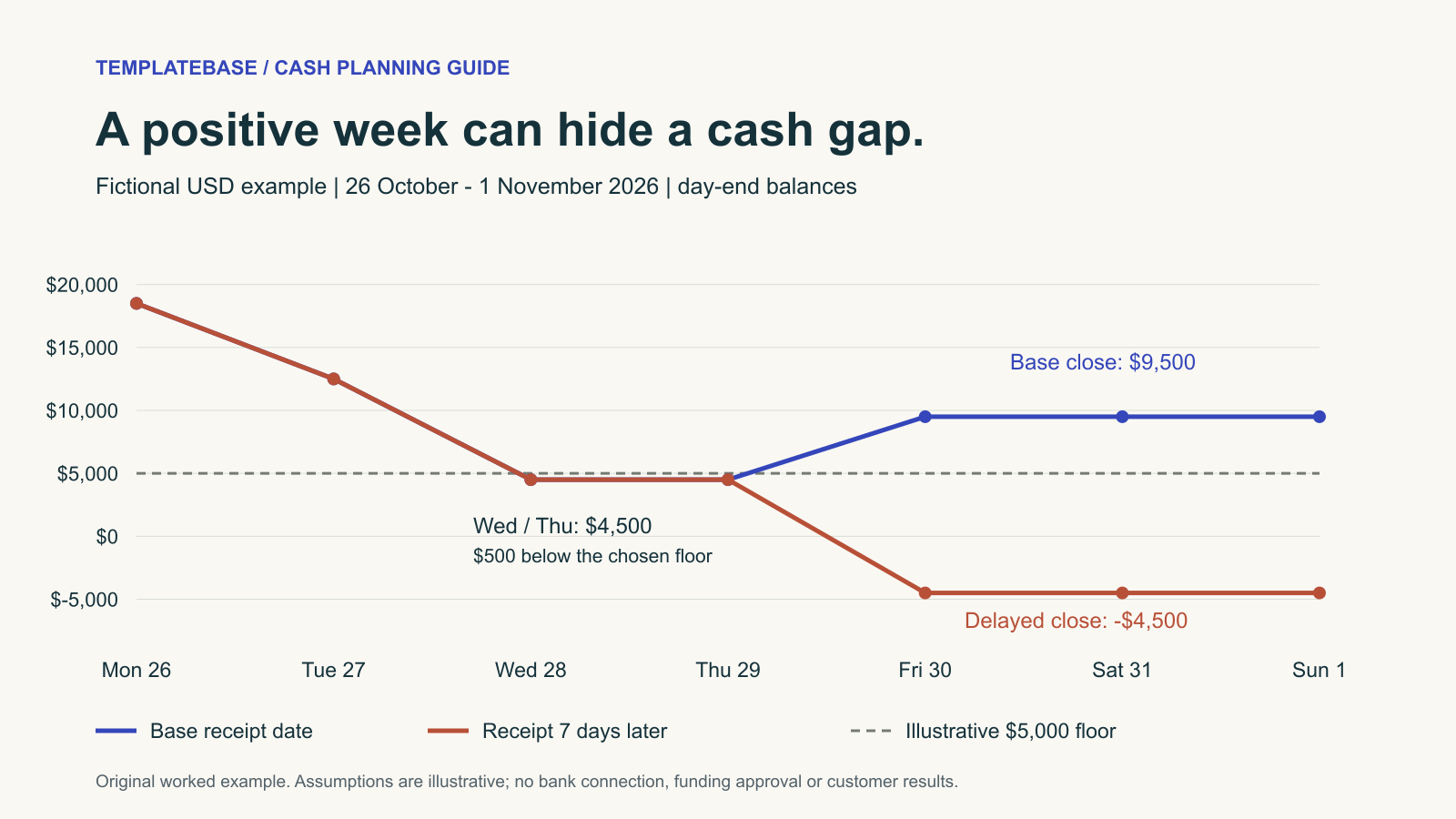
All names, dates and amounts in this example are fictional. A studio starts Monday 26 October 2026 with USD18,500. It expects a USD14,000 client instalment on Friday. Planned payments are USD6,000 on Tuesday, USD8,000 on Wednesday and USD9,000 on Friday. No other movements occur during this illustrative week.
The owner chooses USD5,000 as a review floor. This is an example input, not a recommended reserve level for other businesses. The final column moves the client receipt seven calendar days later, to Friday 6 November, while keeping every payment date unchanged.
| Day | Base receipts | Payments | Base closing | Delayed closing |
|---|---|---|---|---|
| Mon 26 Oct | 0 | 0 | 18,500 | 18,500 |
| Tue 27 Oct | 0 | 6,000 | 12,500 | 12,500 |
| Wed 28 Oct | 0 | 8,000 | 4,500 | 4,500 |
| Thu 29 Oct | 0 | 0 | 4,500 | 4,500 |
| Fri 30 Oct | 14,000 | 9,000 | 9,500 | -4,500 |
| Sat 31 Oct | 0 | 0 | 9,500 | -4,500 |
| Sun 01 Nov | 0 | 0 | 9,500 | -4,500 |
The base week closes at 18,500 + 14,000 – 23,000 = USD9,500. But Wednesday and Thursday close at USD4,500, which is USD500 below the chosen floor. Looking only at the Sunday total would miss those two days.
The delayed case has no receipt inside this week. It therefore closes at 18,500 – 23,000 = negative USD4,500. Its lowest daily balance is also negative USD4,500. The gap to a USD5,000 floor is USD9,500. These are different measures: a USD9,500 floor gap is not a claim that an overdraft of that amount is available or approved.
Reproduce the calculation in a spreadsheet
Use columns A to E for Date, Receipts, Payments, Closing cash and Floor gap. Put opening cash in H2 and your chosen floor in H3. With the seven days in rows 2 to 8, the arithmetic is:
D2 = $H$2+B2-C2
D3 = D2+B3-C3
E2 = MAX(0,$H$3-D2)
Weekly closing = D8
Lowest daily closing = MIN(D2:D8)
Largest floor gap = MAX(E2:E8)
Fill the subsequent-day closing formula down through D8 and the gap formula through E8. Check opening cash plus total receipts minus total payments against D8. In this example, both approaches must produce USD9,500 for the base case.
These formulas illustrate the arithmetic after the inputs are complete. They are not a full validation system. Validate dates, amounts, duplicates and the opening balance before relying on a result. Enter a zero only when you mean that no movement is expected, rather than using zero to hide an unknown amount.
Test a receipt delay without changing the original case
Keep a saved base snapshot. In a separate case, move only the uncertain receipts by the specified number of days. Retain their amounts and identifiers so you can explain why the result changed. The example’s seven-day delay moves USD14,000 beyond this week’s boundary; it does not delete the receivable or automatically change its commercial terms.
For a longer forecast, check which delayed receipts move beyond the final date. Show those items separately instead of counting them both inside and outside the horizon. Keep payment dates unchanged unless a different payment arrangement has actually been agreed and recorded.
This is a day-end model. A receipt arriving after a payment on the same day can cause an intraday issue that a closing balance will not show. Confirm bank cut-offs, weekends and holidays where those details matter; a calendar-day shift is not a bank-clearing rule.
Turn a shortfall into a specific owner review
In the base example, the useful question is why cash reaches USD4,500 on Wednesday. Confirm the USD8,000 payment amount and date with its responsible owner, verify the opening cash and check the evidence for Friday’s receipt. Do not solve the warning by deleting a real obligation from the schedule.
Record each proposed action with an owner, review date and evidence needed to close it. A proposed customer conversation is not an agreed receipt date. A proposed payment change is not supplier consent. Update the forecast only when you have a justified new assumption or recorded agreement; retain enough notes to explain the revision.
If a genuine shortfall remains, discuss the actual facts and obligations with the appropriate finance or professional adviser. A negative projected balance identifies an unresolved planning problem; the spreadsheet does not execute payments or provide financing.
Refresh the forecast each week
- Save a dated copy of the previous forecast before changing it.
- Compare expected movements with what actually cleared. Explain missing, partial or differently dated items.
- Reconcile the new available opening cash. A partially collected invoice should contribute only its outstanding remainder to future receipts.
- Move the horizon forward and remove settled movements from future plans so they are not counted twice.
- Review the next cash low, the date of the first floor breach and any receipts beyond the horizon.
- Carry forward unresolved owner actions with their evidence and next review date.
Keep the prior snapshot if you need to compare forecasts with actual outcomes. Overwriting a forecast without saving it loses that history; a current cash schedule alone does not create a variance archive.
Choose the level of detail your task needs
A weekly template may be enough when receipt and payment timing within each week is not material to your decision. BDC also offers a free cash flow forecasting tool. Compare its current download requirements and scope before choosing a tool.
For an event-level Excel workflow, the Service Business Cash Timing Planner includes editable blank and fictional example files, 91 daily balances, 13 weekly summaries and a delayed-receipts case. It is a manual workbook with fixed prepared ranges and one currency; it does not connect to a bank or arrange funding.
If your question is whether a client engagement is profitable, start with the separate agency retainer profitability example. A cash-timing review and a margin review answer different questions, even when they concern the same client.
[…] before the event. Deposits, supplier dates and payout timing need a dated forecast. The separate weekly cash-flow guide demonstrates that timing […]